Showing posts with label Genesis. Show all posts

Sunday, April 15, 2007

Gen 46 - 50: The End of the Beginning

And we come to the end of the book of Genesis. When I started this project, in July, I estimated that the project as a whole would take "at least a year." And I was right! It will definitely take at least a year!

When I tell people about this project, they often suggest -- in the cheerful, easygoing way that one suggests to someone training for a marathon that they might as well do an ultramarathon -- that I should "do the Koran." Well, the thought has crossed my mind. But for crying out loud, people! Let's make sure I'm going to live that long first!

In terms of page count, I am now 4.4% of the way into the Bible. That took me, lessee, 8 1/2 months. So, at this pace, we're looking at 16 years and change (although considerably less if I can avoid having more lamentable slumps like the one this winter.)

The End of Jacob & the End of Joseph

But I suppose that before I start dancing in the end zone, I ought to actually comment on this week's reading. The text continues in the relatively sprawling storytelling vein that I talked about last week, getting even a little maudlin in a pair of patriarch-blessing-his-sons-from-his-deathbed scenes. I will condense.

Gen 47: The entire household of Jacob -- 66 direct descendents, plus spouses, servants, hangers-on, and livestock, trundle down to the famous "land of Goshen," a chunk of pastureland in Egypt that Joseph secures for them through his buddy, the Pharaoh.


Meanwhile, Joseph continues managing Egypt's food supply in the face of ongoing famine. As the people run out of money, he trades food for their livestock. When they run out of livestock, he trades food for their land. Then, he trades food for their servitude, specifically their agreement to provide Pharaoh with 20% of their crops in perpetuity. Is he saving the people of Egypt by finding ways to keep food distribution going in a time of tremendous hardship? Or is he the most despicable kind of profiteer, taking advantage of a food crisis to strip a starving and terrified nation of its property and freedom? The people of Egypt are said to lean towards the first interpretation: "You have saved our lives," they said. "May we find favor in the eyes of our lord; we will be in bondage to Pharaoh." (25)

[supplementary observation: "Pharaoh" is a really difficult word to spell.]

Gen 48: Joseph brings his boys, Manasseh and Ephraim, to Jacob's deathbed. Jacob gives Ephraim the better blessing, even though Manasseh was born first. Joseph gets a little huffy about this, which is kind of unsporting from a man who has lorded it over his 10 older brothers all his life. Since Jacob, too, was a younger brother -- remember his various tricks on his own big brother, Esau, back in the day -- this is the third generation in a row in which the primary inheritance goes to the "wrong" son.

Gen 49: All twelve of Jacob's sons gather around his deathbed, and he gives them all individual blessings that reflect their personalities or predict their futures. They are an interesting set of blessings. A few seem a lot more like curses, for one thing. You don't want your dad's final message to you to be:
5 "Simeon and Levi are brothers — their swords are weapons of violence.
6 Let me not enter their council, let me not join their assembly, for they have killed men in their anger and hamstrung oxen as they pleased.
7 Cursed be their anger, so fierce, and their fury, so cruel! I will scatter them in Jacob and disperse them in Israel.
Many are highly specific, some to the point of being surreal:
11 [Judah] will tether his donkey to a vine, his colt to the choicest branch; he will wash his garments in wine, his robes in the blood of grapes.
12 His eyes will be darker than wine, his teeth whiter than milk.
That seems like a passage that would mean something really specific to the original audience, but it's kind of lost on us.

Dying, Jacob says that he wants to be buried with Abraham and Isaac, in the cave originally bought as Sarah's tomb back in Genesis 23. Remember how, in that chapter, there seemed to be a real determination to underscore as often as possible that the cave was purchased fair and square? Well, lest we forget, Jacob -- on his deathbed in Egypt -- revisits the point with his final recorded words: "the field and the cave in it were bought from the Hittites." (32)

Gen 50: And in Genesis 50, Joseph lives happily ever after. He lives to 110, and gets to play with his great-great grandchildren. But Genesis ends with some foreshadowing, as Joseph reminds the family that God has promised them a large chunk of real estate up to the northeast. God will lead you back there soon, he says.

Genesis

So there you have it. Genesis took us through the creation and the flood, and traced the adventures of Abraham, Isaac, Jacob, and Joseph. The level of detail continued to increase as the chapter went on, so that we are told (for instance) far more about Joseph's relationship with his brothers than we are about God's creation of the Earth.

After the Flood, God is in fact surprisingly absent from the text, for the most part just checking in periodically to reaffirm his commitment to bless this odd and unruly family. Except for this, he is only present to occasionally dispatch those whose behavior he finds disagreeable, either individually (Er, Onan) or in the aggregate (Sodom, Gomorrah).

Regarding this smiting -- it is frustrating to be told so little about what has set God off. Stuff like this would be good to know. But we aren't told, for instance, what everybody was doing before the flood that made God so angry that he killed everyone -- except the family of Noah, the single righteous man. Noah, you will recall, celebrates his deliverance by getting drunk and knocking up his daughters. This was the most righteous man God could find? (I found it very interesting, too, that the near universal interpretation of what angered God before one of the major smitings, the Tower of Babel, is contradicted by what is actually in the text).

Finally, let's look at what Genesis had to say about my four initial questions:

1. Is God a Republican? Genesis is suprisingly free of prescriptive language. We are given very little guidance in what is or is not appropriate behavior. So, it is hard to pin a philosophy on God at this juncture.

2. Is God Good? This is the most disturbing of the questions, of course, and Genesis lends itself to disturbing answers. God curses his creation, kills on a global scale in the flood, and kills on a regional scale at Babel, Sodom, and Gomorrah. It is hard not to see this as, at best, throwing the baby out with the bathwater.

3. Is there an afterlife? Genesis -- which, significantly, includes the authorized account of the creation of all things -- makes not a single mention of an afterlife.

4. What are God's Family Values? If we are to extrapolate from the behavior of those who find his special favor, a confusing picture emerges. Sleeping with your kids (Noah) is OK, but seeing your father naked (Ham) is anathema. Pimping your wife for safe passage and profit (Abraham) is OK, but not wanting to get your brother's widow pregnant (Onan) is grounds for death. It's a confusing world in the Old Testiment.

The sacrifice of Isaac stands out as a telling moment. The message of that story could have been "stand by your family, no matter what." But instead, the message is "do what you are told, no matter what." This is not anti-family, precisely, but at a point where a strong statement in support of family values might have been made, it was not.


Next week, we put Genesis, and Egypt, behind us. Please join me and special guest Moses next Sunday evening, as Michael Reads the Bible begins the book of Exodus.

Sunday, April 08, 2007

Gen 36 - 45: Joseph Makes Good

You know the story. A hard-working farm boy from the sticks goes to the big, cosmopolitan city in the desert where palm trees grow and things are laid back but sophisticated. He has a hard time at first; he's naive about women, and runs into trouble with the law. But eventually he gets discovered, and through a combination of luck, hard work, and natural charisma, eventually joins the ranks of the rich and famous and finds himself attending parties that the likes of you and I can only dream of.

That, friends, is the story of Joseph.

Genesis 36

But first, it's time out for Genesis 36, the first full chapter of family trees we've seen since Genesis 10. A sample verse (36:24): The sons of Zibeon: Aiah and Anah. This is the Anah who discovered the hot springs in the desert while he was grazing the donkeys of his father Zibeon. Oh Yeah! THAT Anah!

Joseph

Joseph is not Jacob's firstborn -- he is the 12th child and 11th son, if I count 'em right -- but he is the first of the two sons that Jacob has by Rachel, the wife he actually likes, and so Joseph is special. Jacob is none too subtle about playing favorites, dressing little Joseph up in what the New International Version rather disappointingly calls a richly ornamented robe but which you and I know is really a coat of many colors. This, along with the tyke's habits of having dreams that are thinly-veiled predictions of how he is going to rule over all of his brothers, does not endear him to the older boys. So, they sell him to some slave traders, and show Dad the coat of many colors with considerably more red on it than it used to have.

(At this point, there is a break in the story for Genesis 38, a completely unrelated chapter which I think is interesting and will return to. But let's indulge our modern sense of narrative flow and keep going with Joseph for now.)

Speaking of narrative flow, actually, it should be noted that the story of Joseph has a different feel than everything that has gone before. At Genesis 12, I noted that the hypercompressed storytelling of the first chapters broadened out into a more coherent, sustained narrative. At Genesis 37, the style broadens out yet further. The story of Joseph is a full, fleshed-out story with lots of detail and even something resembling character development. It's even a bit long-winded, honestly, and one wonders why there is so much more of it than there is of, say, creation, or explanation of what God really wants and requires from his human creations. That would have been handy.

Anyhoo, Joseph has various wacky misadventures in Egypt. A slave, he nevertheless rises to chief of staff in the household of the captain of the guard. Sexually harassed by the boss's wife (as shown here, at right), he's accused of attempted rape and ends up in jail. Pharoh hears about his ability to interpret dreams, frees him, and appoints him as, basically, Secretary of the Agriculture.

So, Joseph is a real bigshot by the time his brothers come to Egypt to buy grain during a famine. They don't recognize him, but he recognizes them. So, he messes with their heads, makes them jump through hoops, occasionally imprisons one or more of them, and puts them in situations where they have reason to believe they'll be executed, all for the better part of a year before he finally says "hey, it's me, your little brother!" Doubtless they are delighted. At the end of Genesis 45, he sends them home to fetch Dad and bring him back to Egypt, where he can set them up with some good land while they wait out the famine.

And that's the story of Joseph. I think kids like this story, and actually it has all of the elements of childrens' fantasy literature. The boy-hero gets separated from his family, has adventures, becomes important and powerful, and gets to stick it to his siblings in the end. It's a pretty unbeatable formula, when you are eleven. As an adult, I find myself more wondering about the relevance of the tale than anything else.

Genesis 38

Now smack dab in the middle of the Joseph story, as I mentioned, is this quirky little chapter about another of Jacob's sons, Judah. This is yet another chapter that highlights the freakshow family values of one of the great patriarchs. For a religious tradition that is so often held up as forbidding any but the very narrowest range of sexual behavior, JudeoChristianity certainly has a lot of creepy sexuality going on here in its sacred writings.

Judah starts off wholesomely enough. He marries a local girl, the daughter of a man called Shua, whose name we are not told. She is called "the daughter of Shua." Judah lies with her in the customary fashion, no doubt crying out "I love you, daughter of Shua" in the heat of passion, and pretty soon they have three sons, Er, Onan, and Shelah.

Years pass, and Er gets married to a woman who is blessed with an actual name, "Tamir." Unfortunately, Er, Judah's firstborn, was wicked in the LORD's sight; so the LORD put him to death. (7) Yikes! that's bad! And naturally we are curious as to what exactly made Er wicked in the sight of the Lord, so we can avoid making the same mistakes. But this is not revealed.

Following the standard practice of the day, but making the modern reader rather queasy, Judah sends in the second team: Then Judah said to Onan, "Lie with your brother's wife and fulfill your duty to her as a brother-in-law to produce offspring for your brother. (8) Onan is not down with this plan:

9 But Onan knew that the offspring would not be his; so whenever he lay with his brother's wife, he spilled his semen on the ground to keep from producing offspring for his brother. 10 What he did was wicked in the LORD's sight; so he put him to death also.
Well, at least this time we know Onan did wrong. Or do we? There is a tradition that this little tale shows that God hates masturbation -- because spilling semen on the ground is wicked. There is a tradition that it shows God hates birth control -- because deliberately failing to produce offspring while, um, laying, is wicked. But on the face of it, it seems to me that this passage is really about the moral imperative of getting your sister-in-law pregnant if your brother dies without an heir. And yet you never hear anyone going on about getting back to THAT traditional family value!

It goes on. Judah's first two sons having croaked on her, Tamir becomes peaved when the third one, Shelah, isn't sent her way to take care of business once he comes of age. To take her revenge on Judah, she poses as a prostitute (as shown here, at right -- it is very easy to find images for the Bible stories that involve sex) and sleeps with him, taking his staff and seal on consignment. She gets pregnant, and the townspeople tell Judah that his daughter-in-law has been foolin' around. "Bring her out and have her burned to death," cries this stalwart believer in the God of justice and mercy. Then we come to the punchline:

25 As she was being brought out, she sent a message to her father-in-law. "I am pregnant by the man who owns these," she said. And she added, "See if you recognize whose seal and cord and staff these are."
26 Judah recognized them and said, "She is more righteous than I, since I wouldn't give her to my son Shelah." And he did not sleep with her again.
Moral tale? Soap opera? First written dirty joke? I dunno. I'm just reminded of this quotation: "The past is a foreign country: they do things differently there." The people of Genesis certainly seem to approach life with a different set of first principles than most of my friends.

Gentle readers, we are only four chapters from the Genesis/Exodus border. What a long, strange trip it has been, so far.

Sunday, April 01, 2007

Gen 31 - 35: Jacob -- the Middle Years

Genesis 31

Last week, we were looking at the various shams and shenanigans of Jacob, and I have to admit that it never occured to me to think of him as a classic mythological trickster. This is why I need smart readers like yourself, and like the two commenters who suggested the idea. Thanks, commenters.

Having said that, in this week's chapters Jacob seems less inclined to pull fast ones on others than to cry foul about the way that the others are treating him. As chapter 31 opens, Jacob is nervous. His brothers-in-law are grumbling openly that Jacob has cheated their father, Laban, and gathered a great deal of wealth -- herd animals, in this society -- at Laban's expense.

Now, according to what we read in Genesis 30, this grumbling is entirely correct. Jacob did rig a system, using magic decorated tree branches -- really! -- to skim the best animals out of Laban's herds. In Genesis 31, however, the story is told a little differently. His own hard work is stressed:

6 You know that I've worked for your father with all my strength, 7 yet your father has cheated me by changing my wages ten times. However, God has not allowed him to harm me. 8 If he said, 'The speckled ones will be your wages,' then all the flocks gave birth to speckled young; and if he said, 'The streaked ones will be your wages,' then all the flocks bore streaked young. 9 So God has taken away your father's livestock and has given them to me.
The Jacob of Genesis 30 is actively working the system, making sure that the livestock comes out with the proper coloration. The Jacob of Genesis 31 is innocent as a lamb -- streaked, speckled, or whatever. If God makes the flocks speckled than gosh, what can he do about it? It's an interesting about-face.

Anyway, Jacob decides it's time to get out of Dodge, and sneaks off with the wives, the wives' maidservants, the children, the livestock, and the various household functionaries and hangers-on while Laban is busy with the shearing season. They are not exactly travelling light, however -- I get the impression that Jacob's household is a pretty good sized travelling town at this point -- so there is a slow-motion chase scene as Laban comes after them. He catches them after eight days, but it's pretty much an anticlimax. They agree to let bygones be bygones, and to stay in touch.

Part of the reason Laban gives chase is that, at the same time Jacob snuck off, his household gods went missing. Jacob is hurt by the implied accusation, and tells Laban to go ahead and search the whole camp. Rachel, unbeknownst to Jacob, is the one who swiped the gods, and they are right there in her saddlebags. Thinking fast, she stays seated when her father searches her tent, apologizing for not being able to get up because she is having her period. I mention this episode only because I remember seeing it when I was maybe eleven years old, and thinking it was pretty steamy stuff.

Genesis 32 and 33

The next two chapters are about Jacob's return to his brother Esau. Whether out of contrition for his earlier exploits, or because Esau seems to have become a powerful local figure since last they met, Jacob is nervous about the reunion. He choreographs their meeting right down to the minute details, and the exact numbers of goats and cows and donkeys, the order of their presentation, the little speech of presentation that the herdsmen were supposed to make, and the marching order of the sprawling family are all laid out in loving detail. (Esau, as likeable a character as Genesis has yet given us, seems bewildered by all of the fuss and just happy to see his brother again.)

This narrative is interupted at Gen 32:22-32, though, by an episode I find very strange indeed. (And I'm consistant. Both teenage Michael and grad school Michael left notes in the margin here noting their puzzlement. If I remember rightly, this is as far as grad school Michael got in HIS attempt to read the Bible. The big loser.)

Let's take a look:

22 That night Jacob got up and took his two wives, his two maidservants and his eleven sons and crossed the ford of the Jabbok. 23 After he had sent them across the stream, he sent over all his possessions. 24 So Jacob was left alone, and a man wrestled with him till daybreak. 25 When the man saw that he could not overpower him, he touched the socket of Jacob's hip so that his hip was wrenched as he wrestled with the man. 26 Then the man said, "Let me go, for it is daybreak." But Jacob replied, "I will not let you go unless you bless me."
27 The man asked him, "What is your name?" "Jacob," he answered.
28 Then the man said, "Your name will no longer be Jacob, but Israel, because you have struggled with God and with men and have overcome."

OK, what just happened? Anybody? I know from, uh, U2 that "Jacob wrestled an angel, and the angel was overcome," but why? And what does it mean? There seems to be a very alien logic at work here, and Verse 24 is such a sudden transition into the weirdness -- such a non sequitor, really -- that it kind of cracks me up. Or freaks me out. Take your pick.

A few verses later, we learn that to this day the Israelites do not eat the tendon attached to the socket of the hip, because the socket of Jacob's hip was touched near the tendon. (32) And again, I say unto you: How does that follow? The word "because" is supposed to indicate some sort of causal logic, but to my mind there are quite a few missing steps in this particular "because."

Genesis 34: The Unkindest Cuts of All

So Jacob and the family settle in near Esau's place, but things go wrong right away. The son of the local Caananite bigwig rapes Jacob's daughter, Dinah. Or does he? I'm not sure:

2 When Shechem son of Hamor the Hivite, the ruler of that area, saw her, he took her and violated her. 3 His heart was drawn to Dinah daughter of Jacob, and he loved the girl and spoke tenderly to her. 4 And Shechem said to his father Hamor, "Get me this girl as my wife."

I've looked at this passage in a number of translations, and really wish we could get Dinah's testimony on the incident. Jacob and his sons are more than a little upset, but I can't tell why. Three possibilities:

  • Dinah and Shechem liked each other, and did some consensual foolin' around. The boys regard her loss of virginity as a defilement.
  • Shechem really did rape Dinah, and the boys regard her loss of virginity as a defilement.
  • Shechem really did rape Dinah, and her family is outraged and horrified that their loved one has been hurt and disrespected.

It is not at all clear to me whether the first or second possibility is the accurate one. The third possibility seems vanishingly unlikely.

The exact nature of the Canaanite prince's offense would be nice to know, as he and his entire community are going to pay for it. Hamor, the king, suggests that Shechem and Dinah just get married, and offers to pay any bride price that Jacob wants to set. Jacob's sons say this is fine -- with one little catch:

15 We will give our consent to you on one condition only: that you become like us by circumcising all your males. 16 Then we will give you our daughters and take your daughters for ourselves. We'll settle among you and become one people with you. 17 But if you will not agree to be circumcised, we'll take our sister and go."
Hamor, who is a KING and does not have to stand for re-election, agrees and institutes mandatory circumcision. Once this has been done, and all of the men in town are feeling, well, sore -- two of Jacob's sons come to town and kill everyone. All the males, anyway. The women and children they seize and carry off, along with the flocks, herds, donkeys, and wealth.

And again I ask: Are these guys supposed to be setting a good example for how we are supposed to behave in the world?

Genesis 35

Understandably concerned about what the neighbors might be thinking about them, Jacob's clan sets off again. At a place called Bethel, God appears to Jacob and promises yet again that this family is going to produce nations and kings, and that it is their destiny to rule over much of the Middle East. I have not gone back to count, but I believe it's the seventh time God has made this covenant with this family in three generations.

Have a good week!

p.s.

In looking for this week's illustrations, I came across something called The Brick Testament. It is truly strange and brilliant. Check it out.

Sunday, March 25, 2007

Gen 25:12 - 30 -- Patriarchal Attitudes

Isaac

After Abraham, the action in Genesis follows his son Isaac only very briefly before moving on to his grandson, Jacob. Isaac's role seems mostly to be a prop in other people's stories. At the beginning of his life, he is the beloved son that Abraham almost, but not quite, has to kill. At the end of his life, he is going to be deceived by his slippery son. The romantic journey in search of his wife is conducted, as we saw last week, not by him but by his nameless servant.

Everything else about Isaac is covered in Genesis 26, and it is the now recognizable business-as-usual for a local leader in this time and place. Neighbors are befriended or antagonized, stakes are pulled up and moved when the neighborhood gets unfriendly, and an occasional conversation is held with God in which he promises anew that he intends for this family to become very large indeed, and to hold title to truly impressive land tracts. There are also some interesting squabbles over wells that remind us that all of this is taking place in a desert, where water rights are critical.

And, not surprisingly, there is an episode where Isaac makes Rebekah, his wife, claim to be his sister. In this case, however, she does not get farmed out to the local king, and in fact they eventually get found out due to an indiscreet Public Display of Affection. So in his marriage, as in other aspects of his life, Isaac seems perhaps a little happier than his dad or his son. Maybe being the obscure one isn't so bad.

I haven't been able to find a good image of Isaac where he isn't either a boy trussed up for slaughter, which I've already used, or an old man about to be deceived on his deathbed, which I'm about to use. So, here's a picture of the pioneering science fiction author Isaac Asimov.

Jacob

Jacob is another major Old Testament character who gives me issues. Are we expected to think well of these guys? Are they supposed to be moral exemplars? Because Jacob is definitely not the kind of guy you would want to buy a car from. He is tricky and deceitful, pulling off three major scams during the section of his life covered by this week's reading.

The first is the famous "birthright for a mess of pottage" episode. Jacob's twin brother Esau, who is elder by a few seconds, comes home from a long hike in the bush. He is extremely hungry -- he says he is about to die (25:32) -- and asks if he can share the lentil stew that Jacob is making. Jacob makes a deal: he'll share his lunch, on the condition that Esau give up his birthright. Esau gives in, and there is a suggestion that he is the bad guy of the story, a fool who has shown contempt for his station in life. We are perhaps supposed to admire Jacob's shrewdness, but it's tough for a naive reader like myself not to think badly on a man who won't lift his finger to feed his hungry brother without exacting an enormous price.

The years pass. As Isaac is on his deathbed, Jacob takes the opportunity to punk Esau again. (He's egged on by his mom, who is scandalized that Esau married a local girl instead hooking up with one of his first cousins like a respectible person). He impersonates his brother before their dying father, who is tricked and bestows his blessing on the wrong son. Once given, this kind of blessing apparently just can't be taken back, and even though Isaac and Esau figure out Jacob's duplicity almost immediately there is nothing to be done for it. Jacob ends up having stolen not only Esau's birthright, but his destiny as well. He'll get riches, nations, and people bowing down to him, while Esau only gets to live by the sword and serve [his] brother. (27:40)

In the third episode, Jacob moves on to swindle his father-in-law, Laban. Having arranged that he will be given all of the striped or mottled lifestock in Laban's herds, he makes charms out of tree limbs, stripping away bark so that they look striped and mottled. He has the best of the beasts mate in the presence of these charms, and their offspring come out striped and mottled. Eventually, he ends up walking away with all of Laban's best animals. I'm not sure if I could make this trick work, myself. Nor does it make me feel like Jacob is a patriarch I'd want to do much business with.

Good Old-Fashioned Family Values

To be fair, Jacob has a legitimate grudge against Laban, who is not only his father-in-law but also his father-in-law. And, of course, his uncle. Let me explain. Rather than marry outside of the family like his uncouth brother, Jacob goes off to seek a bride at the compound of uncle (great uncle, really) Laban. There, he falls in love with the lovely in form (29:17) Rachel, and agrees to put in seven years of labor in exchange for her hand in marriage. But after seven years, Laban pulls a bait-and-switch of his own and offers the near-sighted (and apparently less lovely in form) Leah, Rachel's big sister. "If you take this one and put in another seven years, though, you can have them both" offers Laban, so in the fullness of time Jacob has both of the two sisters as wives.

Family life in Jacob's household has its share of complications. Jacob doesn't like Leah, but she gets pregnant first. "Surely my husband will love me now," she says when her first son is born(29:32), but like many an unhappy young mother soon finds out otherwise. Nevertheless, she bears him three more sons, giving each of them names that are basically Hebrew puns for "I wish my husband thought of me as more than a contemptable vessel for his progeny."

Meanwhile, Rachel has not produced any bundles of joy and is getting jealous. She has an idea: "Here is Bilhah, my maidservant. Sleep with her so that she can bear children for me and that through her I too can build a family." (30:3) So, Jacob goes along with this, and another son (Dan) is born. And Jacob goes along with this again, and another son is born. Rachel (unlike her great-aunt Sarah in similar circumstances) is delighted, and thumbs her nose gleefully at her big sister. Bilhah's feelings about the arrangement are not recorded.

Now it's Leah's turn to be jealous, so she thrusts HER maidservant at Jacob with a knowing look, and two more sons are cranked out.

Then, Leah's son brings her some mandrakes. Rachel wants some of them.

15 But [Leah] said to her, "Wasn't it enough that you took away my husband? Will you take my son's mandrakes too?" "Very well," Rachel said, "he can sleep with you tonight in return for your son's mandrakes."
16 So when Jacob came in from the fields that evening, Leah went out to meet him. "You must sleep with me," she said. "I have hired you with my son's mandrakes." So he slept with her that night.
Another son results. You really have to feel for poor, deluded, squinty Leah. This time, she says, my husband will treat me with honor, because I have borne him six sons. (30:20) Yeah, sure he will.

Eventually, even Rachel manages to produce a son, at which point by my count the household consists of one man, two wives, two very special handmaids, eleven sons, and a daughter.

Discussion questions:
  • Who all is covered by Jacob's work-based health plan? What if he lives in Masschusetts?
  • Your maid has, according to your instructions, borne two children by your husband. What is an appropriate tip?
  • If your partner traded your sexual services for some mandrake plants, would this have any impact on your self esteem? Explain.
  • When inviting this family to a formal occasion, should you provide seating for 3 adults plus children, or 5 adults plus children?

Heaven.... I'm in Heaven....

One last detail. At Genesis 28:12, Jacob has a vision of heaven -- in fact, a stairway to heaven. It is described as a habitation of God and angels. However, there is no mention of it being a place of the afterlife, which means that 30 chapters into the Bible, there has still been no mention of the idea of life after death.

Sunday, March 18, 2007

Gen 22- 25:11 -- Finishing Up With Abraham

Abraham is definitely the star of the show so far. By the time we finish up tonight, the chapters of Genesis thus far will be apportioned like so:

Creation: 2 chapters
Fall of Man: 3 chapters
Noah and the Flood: 4 chapters
Begetting: 2 chapters
Abraham: 13 chapters!
So, counting by sheer real estate on the page, tonight we're looking at the golden years of the man who is 6 1/2 times more important than creation! We'll proceed chapter by chapter, starting with what many people think of as one of the most disturbing episodes in the Bible.

Gen. 22: Abraham and Isaac

Abraham is apparently just going about his daily business when God gets his attention and gives him some tough instructions: Take your son, your only son, Isaac, who you love, and go to the region of Moriah. Sacrifice him there as a burnt offering on one of the mountains I will tell you about (2). So Abraham prepares to do just that, hiking three days with his boy to the designated spot. Isaac is a perceptive lad, and asks a question that I imagine is one of the first recorded instances of dramatic irony: "The fire and wood are here, but where is the lamb for the burnt offering?" (7) Which is a great line, because the "lamb" is..... ah, never mind. It's not funny if I have to explain it.

Abraham trusses up Isaac and puts him on the alter, and actually picks up the knife to kill him before God tells him to hold up: Do not lay a hand on the boy.... Now I know that you fear God, because you have not withheld from me your son, your only son. (12) At this point, they notice an unfortunate ram has stumbled upon the scene, and it becomes the replacement sacrifice animal as Isaac rubs his wrists, laughs nervously, and says "great joke, Dad, you really had me going."

The point of this story is of course to illustrate Abraham's total devotion to God, and the virtue of his willingness to sacrifice the one thing in life most dear to him in subjegation to God. It is, indeed, one of the first episodes in the Bible with a clear moral lesson to it, which is: Do Like Abraham! Whatever God Says, Do It Immediately and With No Questions.

There are two things that make this story so uncomfortable to We Moderns, I think, and the first one is of course that for God to command someone to kill their child just seems pretty messed up. Really, really messed up, in fact. Like, comprehensively messed up. This may be a cultural thing in part; we've been long blessed with an extremely low infant mortality rate, and we are likely as protective of children as any society anywhere, ever. But still.

Secondly, the idea of testing someone without their knowledge seems awfully disempowering and passive-aggressive (God would never have got this one by the Human Subjects Committee). OK, he's God, so he doesn't have to be polite. But there's a certain arbitrary nature to the test that is disturbing. Abraham wins the day by exhibiting the virtue of complete obediance to God. But, you can easily imagine an alternative story where Abraham exhibits the virtue of dedication to family and posterity by refusing to sacrifice Isaac, and God saying "Yep, you were right to refuse, for no man who murders his offspring is fit to live." In a sense, Abraham succeeds by guessing correctly what God really wants him to do, which is not an easy trick given that God is asking him to perform an abomination. And that -- the sense that Abraham really just makes a lucky guess -- kind of undercuts the moral message of the episode. But maybe that's just me.

Gen. 23: Let's Buy a Cave!

From one of the most emotionally fraught of the Bible stories, we move on to one of the most obscure. Sarah dies at 127, and Abraham went to mourn for Sarah and to weep over her. (2)

After this florid display of emotion, which I have reprinted in its entirety, we get to the important stuff: how to acquire the rights to a good place to bury her? Abraham talks to the Hittites, and they don't think there will be a problem finding a good spot for sale. Abraham asks them if they'll talk to a local strongman, Ephron, about it. They say "sure, no problem." Then, Abraham goes to town and meets Ephron, who says "you know what, I'll just give you the spot you want." "No no no," says Abraham, "I do want that spot, but I want to pay for it." And Ephron is all, like, "OK, if that makes you feel better, how about four hundred shekels?" And Abraham is, like, "that sounds good."

This story goes on and on, occupying as much text as the sacrifice of Isaac (or a good three times as much text as the Tower of Babel), and you can not but wonder why we need to know this much about Abraham's real estate hagglings. From the historical perspective, one notes that the story is quite specific about the fact that the land was legally transferred. The parcel, it's noted very preciselyin both verses 17-18 and then again in verse 20, "was deeded to Abraham." In terms of a religious or moral lesson, however, I'm hard pressed to take anything from this except perhaps the benefits of pre-need funeral planning.

Genesis 24: Romance Amongst the Ancients

Back to a coherent story line for the longest book of the Bible so far, in which we go on a long journey with Abraham's most senior and trusted servant. He is called "the servant," and is charged by Abraham with finding a wife for Isaac. But, the local girls in Canaan are right out. What Abraham wants is for Isaac to marry a nice girl from among his cousins back in Nahor. [Involuntary modern interjection: Icky! We are glad to note, though, that those nice second cousins, the daughters of Lot, aren't ever nominated as possibilities.]

The servant takes the long trip to Nahor, parks by the village well, and tells God that he'll regard the first girl to offer water to his camels as The One for Isaac. Happily, the first girl along offers water to the camels, and it turns out that she is very desirable bride material indeed, being Rebekah, another of Isaac's second cousins. The servant goes to her parent's home, and, in a passage which I have to say leaves a bit to be desired literarily, tells them about his mission, trip, and encounter with Rebekah in almost the exact language in which the events themselves were originally described. Is there an echo in here?

The parents, desparate perhaps to shut their long-winded visitor up, say "she can leave in ten days!" but the servant says, "nope, gotta leave now," and since Rebekah is a real sport about it -- I will go (58), she says, in a nicely understated way -- they send her off with their blessing.
After the long trip back to Canaan, they meet Isaac. Then the servant told Isaac all he had done (66), but we are fortunately spared yet another blow-by-blow. Isaac and Rebekah move into Sarah's old tent -- she became his wife, and he loved her. (67) So that's how it worked, apparently, before online dating and all that.

Gen 25: The Death of Abraham

Abraham eventually lives until 175 years until, as the King James version puts it, he gave up the ghost. (8) He is buried with Sarah, which has the advantage of not requiring another round of real estate wrangling. We're not told, though, how his second wife felt about it. The second wife is Keturah, whose name appears only twice and in conjunction with the six sons she bore Abraham and their various illustrious decendants. Whether or not she ever had to go through the "tell them you're my sister!" routine is not mentioned either. In any event, it seems like she gets very short shrift indeed next to Sarah, which is why I encourage any of you reading who might have a daughter on the way to consider naming her "Keturah." It's pretty enough, and way underused.

Thanks for reading, my friends. See you next week.

Sunday, March 11, 2007

Gen: 17 - 21: More Fun With Abraham

I've been listening to a series of lectures on the history of human ideas by a surprisingly British bloke named Felipe Fernández-Armesto. According to Dr. F-A, religious fundamentalism is a 20th-Century idea, originating in the theology department of Princeton University in the 1910s as a means of putting religion on a scientific basis. The reasoning seems to be that if you were going to have testable theological hypotheses, you needed to have an objective point to start from, and declaring scripture as infallible was a means of rendering it objective. Everything else that has happened with Christian fundamentalism since, Dr. F-A implies, is the result of that idea escaping the lab.


Now, that idea is pretty darn interesting in its own right, but it also casts an interesting light on the current project. In a way, what I've been trying to do here is think like a fundamentalist. What if the Bible IS the infalable truth, every last word of it? What does that imply about God, the world, and the fine art of being human?
Or, perhaps, what does it say about fundamentalists that they are willing to hitch their wagon to the idea that the Bible is the infalable truth, every last word of it? My feeling this far, I'd have to admit, is that you would be worshipping a God of very inconsistent behavior, and who was far from having the best interests of humanity at heart. Moreover, you would be basing your faith essentially on a scrapbook, a text that provides remarkably little in the way of narrative or practical guidance.

I'm embarassed to admit this much arrogance, but here goes: when I hear someone profess the literal truth of the Bible, I always think to myself, "fibber!" There is just too much of the Bible that is random, incoherent, mean-spirited, and internally inconsistent, not even to mention inconsistent with the conservative Christian lifestyle as it is usually practiced, for anyone NOT to take it with a least a few grains of salt. Against this rather bland idea, fundamentalists have always manifested a faith-of-our-fathers mystique, the tacit notion that they are simply humble believers in the footsteps of countless generations of humble believers before them. It is an interesting turning of the tables to contemplate that perhaps those countless generations, at least in the few hundred years when literate laypeople had access to scripture, actually regarded the Bible with a good deal of reverence but also with a dash of salt to taste.

Genesis 17

After the covenant-fest of last week's reading, it shouldn't have surprised me that Genesis 17 is all about another covenent. This one is, you might say, the unkindest covenent of all -- circumcision. God changes Abram's name to Abraham (a-ha!), gives him rights to the land of Canaan, and sets him up as the head of a line of monarchs. In return, every male in his household or in the household of his descendents needs to undergo circumcision. Born into the family, or bought as a slave -- this, it is spelled out, doesn't matter. Everybody gets circumcised. Why? it will be the sign of the covenant between me and you. (17:11) Why that and not, say, a distinctive haircut? Not addressed.

Let's take a quick look at part of that covenant:

7 I will establish my covenant as an everlasting covenant between me and you and your descendants after you for the generations to come, to be your God and the God of your descendants after you. 8 The whole land of Canaan, where you are now an alien, I will give as an everlasting possession to you and your descendants after you; and I will be their God.
Next to this, in the handwriting of my younger self, is written "polytheism?" And I agree with the younger me that God's wording here does not seem that of an infinite, universal, and singular god. To say "I am going to be the God of you and your ancestors" raises the question of whether the speaker missed the memo about monotheism. Unless other peoples had other gods, why would it make sense to specify "I going to be YOUR god"? But perhaps I am splitting hairs. Let's move on.

Abraham can sire a line of kings because Sarai, now renamed Sarah, is going to bear him a son at age 90. Ishmael, his son by Sarah's maid, doesn't count, but Abraham persuades God to let him be the father of nations, too.

Sodom and Gomorrah

We are told only vaguely that Sodom and Gomorrah are really nasty places, but indeed the inhabitants don't come across as people you'd want to hang out with. Two angels having dropped in on Lot, Abraham's nephew who lived in town, a ruckus ensues:

4 Before they had gone to bed, all the men from every part of the city of Sodom—both young and old—surrounded the house. 5 They called to Lot, "Where are the men who came to you tonight? Bring them out to us so that we can have sex with them."
Lot knows how to treat a guest, but his problem-solving is a little unsettling for the modern reader.

6 Lot went outside to meet them and shut the door behind him 7 and said, "No, my friends. Don't do this wicked thing. 8 Look, I have two daughters who have never slept with a man. Let me bring them out to you, and you can do what you like with them. But don't do anything to these men, for they have come under the protection of my roof."
Subsequently, you will remember, the cities of the plain and all who live in them are destroyed by a rain of burning sulfer. You will also recall the story of Lot's wife, who made the mistake of looking back at the destruction. This turns out to be another of the hypercompressed Old Testament tales. I remember it from Sunday school as a matter of someone who had been warned multiple times in no uncertain terms against looking back wrestling with their faith in God, failing in the spirit, and giving into temptation. There was a definite message, in this telling, that Lot's wife pretty much deserved to be a piller of salt, since she just wasn't willing to listen to God's instructions.

Well, maybe. But here are the relevant lines, in full. At 19:17, one of the angels says "Flee for your lives! Don't look back, and don't stop anywhere in the plain! Flee to the mountains or you will be swept away!" Two paragraphs of negotiation about where the family should flee to follow. Then, the destruction of the cities, and the stark sentence: 26 But Lot's wife looked back, and she became a pillar of salt. So, any speculation about WHY Lot's wife got the treatment, or whether she deserved it, is really very much on thin ice. It certainly doesn't seem like she got a terribly detailed warning.

Good Thing All of the Sexual Deviants Have Been Wiped Out

So it's just Lot and his two daughters, refugees from Sodom living in a cave in the hills.

31 One day the older daughter said to the younger, "Our father is old, and there is no man around here to lie with us, as is the custom all over the earth. 32 Let's get our father to drink wine and then lie with him and preserve our family line through our father." 33 That night they got their father to drink wine, and the older daughter went in and lay with him. He was not aware of it when she lay down or when she got up.

34 The next day the older daughter said to the younger, "Last night I lay with my father. Let's get him to drink wine again tonight, and you go in and lie with him so we can preserve our family line through our father." 35 So they got their father to drink wine that night also, and the younger daughter went and lay with him. Again he was not aware of it when she lay down or when she got up.

36 So both of Lot's daughters became pregnant by their father. 37 The older daughter had a son, and she named him Moab; he is the father of the Moabites of today. 38 The younger daughter also had a son, and she named him Ben-Ammi; he is the father of the Ammonites of today.

Is it just me, or does this little story make Ham's treatment by Noah seem a little excessive? Oh, incidentally, a footnote indicates that Moab "sounds like the Hebrew for 'from father'." Isn't that a nice family touch?

In Genesis 20, meanwhile -- Abraham, ever the pragmatist, lets another king hook up with poor Sarah under the pretext that she's his sister. Despite the fact that she is 90 years old at this point, darned if the gambit doesn't work again, and Abraham comes out of the bargain with sheep, cattle, male slaves, female slaves, plus a thousand shekels of silver (roughly $5200 at the current market rate for silver, but keep in mind that the cost of living was much lower and there was no cable bill).

It is maybe belaboring the obvious to point out that the Bible is pretty baffling as a guide to moral behavior in these passages. The vague nastiness of Sodom and Gommorah are obviously frowned on very severely indeed -- but, our heroes, who are apparently supposed to be models of righteousness, are involved in some pretty explicit nastiness of their own. What's the take-home lesson supposed to be here?

Until next week....

Monday, March 05, 2007

Gen 12-16: I Assume this Abram Guy is "Abraham."

When I left off at the end of Genesis 11 last week, I didn't realize I was at a major turning point. The next heading was "The Call of Abram" -- I'm assuming that "Abram" is the same name as "Abraham" -- and I assumed that the narrative would continue in the hyper-compressed fashion that I've described in the last few entries.

In fact, there's an abrupt change as soon as Abram is on stage. The text opens up, and we start to get a considerable amount of detail, some supporting characters, and a coherent flow of events. Many of the events, mind you, seem pretty arbitrary to modern ears -- e.g. why is there all of a sudden a war between the four kings and the five kings in 14:8 to 14:12? Don't you usually need a pretext for a war? [space here for your cynical comments.]

On the other hand, sometimes you can get a glimpse of real live humanity, thinking the same way that you might, and that is kind of new and exciting. In 13:5 to 13:13, Abraham and his brother Lot decide to go their separate ways, because their respective entourages are getting too big and the herdsmen are quarreling. And you think: "yeah! they were worried about overgrazing, and realized that together they were a more concentrated grazing enterprise than the land could support." Or, after Abram gets his wife Sarai's maid pregnant, Sarai is pretty pissed at the maid, even though the whole thing was her own idea. And you think, "yeah, that rings true. She'd still be pissed."

These five chapters follow Abram for years of wanderings, before God gives Abraham and his descendents all of the land from the river of Egypt to the great river, the Euphrates. (15:18) [Note to Israeli nationalists: Think Bigger.] This is actually the third and grandest of three land-granting covenants God makes with Abram in this section [the historical interpreter of the Bible on my left shoulder keeps saying, "man, three covenants! They REALLY REALLY REALLY wanted to get their claim to the land established]. It is also the most gruesome, capped by an apparition of a floating firepot and torch that glides between chunks of a cow, a goat, and a sheep that Abram had earlier killed, cut in half, and laid out in a symetrical pattern. [Note to wedding planners: this adds a nice touch of solemnity to any ceremony.]

The family values of Abram are not entirely squeaky-clean by modern standards. In addition to the business with the maid, which if I remember right will become important later, Sarai also has this episode to think back on as she reminisces about married life:

12:10 Now there was a famine in the land, and Abram went down to Egypt to live there for a while because the famine was severe. 11 As he was about to enter Egypt, he said to his wife Sarai, "I know what a beautiful woman you are. 12 When the Egyptians see you, they will say, 'This is his wife.' Then they will kill me but will let you live. 13 Say you are my sister, so that I will be treated well for your sake and my life will be spared because of you."

14 When Abram came to Egypt, the Egyptians saw that she was a very beautiful woman. 15 And when Pharaoh's officials saw her, they praised her to Pharaoh, and she was taken into his palace. 16 He treated Abram well for her sake, and Abram acquired sheep and cattle, male and female donkeys, menservants and maidservants, and camels.


This largesse -- let us be frank: the loot he gleaned from pimping his wife to the pharoah -- seems to be the basis of Abram's rise as a promenent man in political and economic life, if I'm reading this and subsequent verses right. So, when Sarai flashes some fairly serious 'tude in Gen. 16, I am disinclined to judge her harshly.

Much happens. There's a long journey, the episode in Egypt, a return journey, the split with Lot, a war, a mission to rescue Lot after he gets kidnapped, some diplomatic talks with other local kings, three big covenants, and the goings-on with the maid -- there is quite a bit going on in these five chapters. But, at the rate we've been charging through the Great Bible Storys up to this point, I thought we were going to have the sacrifice of Issac in Genesis 12 and be on to the next item by Genesis 13. Abram is clearly an important figure to merit this much text; I confess I hadn't realized just HOW important he is. I guess its a symptom of my irredeemable moderness that I wish I could find him a little more likeable.


Until next week, my friends.

Sunday, February 25, 2007

In which Michael5000 returns to the task at hand

Gen 9:18 - 11 has a lot of geneology in it. I don't know about you, but I find listings of who begat whom a little weak as sacred text.

There are two ways of looking at the Bible. Well, there are gazillions of ways of looking at the Bible, I suppose, but I think this two-class system is pretty reasonable:

  • religiously -- the Bible is a sacred text, a message from God to his creation, or

  • historically -- the Bible is the collected writings of a society from a place, time, and context far from our own.

Old Testament geneology is easy to explain historically, as it's just a paternity-obsessed culture's method of establishing a legacy for themselves, as a society and as individuals. But in trying to look at the Bible religiously, it's a little harder to see how the geneologies make the cut. To know that, for instance, Arphaxad was the father of Shelah, and Shelah the father of Eber [10:24] is all fine and good -- I guess -- but how does it help me understand God, or to become a better person? I suppose that, taken in the aggregate, an overall message of "lineage is important" might be drawn, but this seems a little oblique.

I bring this up not only because geneology is so notoriously abundant in Genesis, but because the meatier episodes of today's readings are also easy to interpret historically, but hard to swallow religiously. Take, for instance, the matter of:

Noah's Family Values

The floodwaters having receded, Noah plants a vineyard. Soon, he is making wine, and shortly thereafter he is passed out naked in his tent. (I am not being flip: he became drunk and lay uncovered insdie his tent. [9:21]) Ham, one of his three sons, sees him in this condition and tells his brothers. Here's the full description of the incident: Ham saw his father's nakedness and told his two brothers outside. [9:22] The two brothers, good lads both, go inside and cover Dad up.

What happens next is pretty bizarre. Noah wakes up, finds up that Ham saw him naked, and because of this puts a curse on Canaan, Ham's son, condemning him to be a slave to his brothers. With no further commentary offered, we are apparently supposed to think that Noah is righteous in doing this.

The historical interpretation? A slam dunk. The story provides Noah's own blessing of the Israelites' conquest and enslavement of the Canaanites, whom the accompanying geneologies show to be decended from Canaan (Hence the name, yeah?).

The religious interpretation? Troubling for anyone who has ever seen a parent naked. It's awfully hard to see Noah as a representative of Godliness as he condemns his grandson to slavery for his father commiting a gesture of disrespect on the scale of putting his elbows on the dinner table. And, to the extent to which this story has the imprimiteur of God's word, it does not make a strong case for a family-friendly Old Testament God.

The Tower of Babel

Here is another Genesis story, so integral in our culture, that is almost unbelievably compact:

Then they said "come, let us build ourselves a city, with a tower that reaches
to the heavens, so that we may make a name for ourselves and not be scattered
over the face of the whole earth." But the Lord came down to see the city
and the tower that the men were building. The Lord said, If as one people
speaking the same language they have bugun to do this, then nothing they plan to
do will be impossible for them. Come, let us go down and confuse their
language so they will not understand each other."
[11:4-7]

Historically, no problem. It's a twofur story, explaining both the mystery of diverse languages and the ruined ziggerats you would bump into occasionally out east.

Religiously, we are generally told that this is a story about human arrogance and divine punishment. The people of the city, as I was taught, challenged God or sought to outdo God by building their cities so high, and so naturally set themselves up for a comeupance.

But here's the surprise -- that tale of hubris punished isn't in the text. What you've actually got in the text is a group of people acting with what most of us would consider commendable ambition to build a city that fostered community and commanded respect. God doesn't set out to punish them, he sets out to thwart them. With everyone speaking the same language, he says, "nothing they plan to do will be impossible for them." This is what parents and teachers say hopefully of promising children. But for God, this is a bad thing, and must be stopped.

I find the notion that God hates the human ambition to build and create very difficult to swallow. And if the yardstick for excessive amibition is building cities with tall buildings, well -- uh oh.

See you next week. I promise.

Tuesday, September 05, 2006

Gen 6 - 9:17: A-Boatin' We Will Go!

OK, pop quiz. How many of each animal did Noah bring on the ark?

Jan Brueghel the Elder: The Entry of the Animals Into Noah's Ark
---------

The answer depends a little on where you look. In Gen 6:19-20, God tells Noah to bring two of each kind of animal. Then, in Gen 7:2-3, it's seven apiece of clean animals (cats, one often hears, are very clean animals) and two apiece of unclean animals. Then, in the footnotes, my particular Bible says that seven probably means seven pairs.

Did you know about this? It's a big surprise to me. Two is such a, um, intuitive number of species-preserving animals to pack for a long trip. Seven (or fourteen), although definitely superior from a genetic-diversity point of view, seems kind of random.

The Flood

OK, one of the key questions I'm wrestling with in these scribblings is "Is God good?" Since the mere posing of this question suggests the possibility of judgement, and of a finding in the negative, an immediate corrolary question is "What if God isn't good, huh? What then, wiseass?"

And indeed, what then? Is it right, in the face of a universe-creating power, to merely gape in awe, to live as it were in dread of God? If one feels that God has misbehaved, should one mention this to him? Is it polite? Is it safe? How about mentioning it in a blog? Is that a one-way ticket to eternal damnation? Hope not.

There is the school of thought, of course, that God and good are inseperable concepts, and that if God did it, it must be right. We are quite incapable of outthinking God, the reasoning runs -- have some humility in the face of a power that is infinitely, unthinkably greater than yourself, and give the back-seat driving a rest.

And actually, this arguement makes a certain amount of sense to me, intellectually. But, for better or worse, I've never been able to turn off the facility of judgement that I was somehow (ahem) created with. If I am indeed a product of God, he made something with the (insignificantly tiny) ability to talk back. If he doesn't like it, he has no one to blame but himself.

I bring this up because the Flood seems a bit excessive for my tastes. To be fair, we aren't told just what humans were up to that so irked God -- just that the Lord saw how great man's wickedness on the Earth had become, and that every inclination of the thoughts of his heart was only evil all the time (6:5). Or, to say it circularly: God saw how corrupt the earth had become, for all the people on earth had corrupted their ways (6:12).

One specific is given: people are full of violence (6:11). So, God decides that I am going to put an end to all people, for the earth is filled with violence because of them. I am surely going to destroy both them and the earth (6:13).

Talk about circular. Humans are violent -- so God decides to waste 'em. The earth is tainted by human violence -- so God is going to smash it to bits. As a moral statement, this seems neither consistant nor coherent, and frankly I was hoping for better leadership. God seems to be operating here with the logic of petulant children and dangerous drunks.

Or, maybe that is only true if you presuppose that humans are morally significant in God's eyes. Without that assumption, from the dread-of-God perspective, God's decision could be as utilitarian as a carpenter saying "damn, this 2 x 4 is infested with termites. Into the burn-barrel it goes." ("...except for this one cute little termite, I'll spare him...")

Anyway....

God as Republican shows up again in Genesis 9, which begins with another restatement and amplification of the now-familiar "everything on Earth belongs to you humans, knock yourself out" speech (1-3). Immediately following this is an absolutely cut-and-dry mandate for the death penalty: whoever sheds the blood of man, by man shall his blood be shed, for in the image of God has God made man (9:6).

Family values are not addressed as such in this section -- although, wait 'til next week -- but there is a passing condemnation of humanity that is a bit stinging in its casualness: The Lord smelled the pleasing aroma (Mmmm! burnt sacrifice!) and said in his heart: "Never again will I curse the ground because of man, even though every inclination of his heart is evil from childhood. (9:21)" Ouch!

The Afterlife has been mentioned in these very key first nine chapters of the Bible.... not at all!

Details, Details....

The Noah story is really the first so far that is long enough to have any real narrative line. The most charming thing about it as a story is the wild inconsistancy of detail. In places, there is sudden abundance of precision -- the dimensions of the boat, the exact day of Noah's life on which it started raining, and the elaborate process of releasing birds to search for dry land. Of other areas that spark a readers interest -- what is is like to live on a boat for hundreds of days with only your immediate family and the Bronx Zoo for company? what did people do to deserve this, that we might avoid making the same mistakes in the future? was the rise in water level concomitant with sudden dramatic melting of the Antarctic and Greenland ice sheets? -- there is not a word.

Then, there is a nice piece of poetry that ends Genesis 8 on a hopeful note. The floodwaters receding, God is pleased by Noah and his family, and decides that one destruction of the world is enough:

As long as the earth endures,seedtime and harvest,
cold and heat,summer and winter,day and nightwill never cease. (8:22)


NEXT: "The Tower of Babel," or, Nxhggl mnzzch gilllm ba fortiax!

Wednesday, August 23, 2006

Gen 4 - 5 -- After the Fall, Before the Flood

All right, let's get back into this Bible thing. I've been travelling a lot, which has really cut into progress here. My apologies.

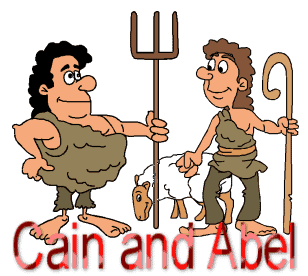
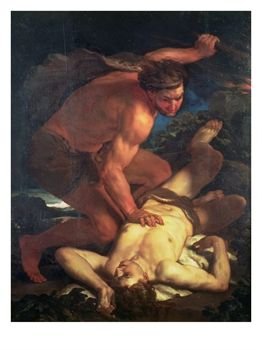
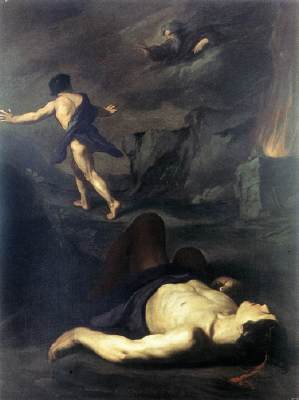
Cain and Abel

Genesis 4 is all about Cain and Abel. This is another story that everybody knows in outline. You are even now thinking to yourself, "yeah, there's Cain, and he kills his brother, and God gets angry at him." And that's exactly right. The surprising thing -- the strange thing -- is that you've pretty much got the whole story right there. That's really all there is to the story.

As the chapter starts, Eve gives birth to Cain. "With the help of the Lord I have brought forth a man," she says, in a voice no doubt dripping with irony -- it has only been nine verses since God served notice that he was going to "greatly increase your pains in childbearing." Then Abel comes along, and soon the two brothers have pursued their separate career paths, Abel in ranching and Cain in farming.

In a while, they both produce offerings to God. Abel, naturally, brings meat; Cain, veggies. God likes the meat, but did not look with favor on Cain's veggies. "Why not?" you ask. Yes, that seemed like an important point to me too. But -- and this is the strange part, to my eyes -- no reason is given. None. The OCB, in a nice piece of understatement, notes that "this appears to be a literary gap." Yes indeed it does, and it's a gap that renders the story, however well known, to be completely meaningless for all intents and purposes.

Cain kills Abel in a fit of jealousy, God confronts Cain, Cain gets to say his money line, and then God curses him and banishes him. Adam must be pleased to see his boy take after him so closely; in my edition of the Bible, both father and son are in turn cursed and outcast on the very same page.

The OCB notes that "many themes appear in this story, including sibling rivalry, the attraction of sin, crime met with punishment, the futility of pretense before God, and the moral distinction between civilization and barbarism." Which is all true, I suppose, but it's also giving the story much more than its literary due. These themes are evoked, but not developed, so while the story packs a certain cultural punch by virtue of being extremely well known (which is, let's face it, only because it's so close to the beginning) it doesn't really say much.

Begin the Begittin'

After Cain's expulsion, he, ahem, lays with his wife -- I'll avoid the obvious and age-old question of where she wandered in from -- and they begit Enoch. "Cain was then building a city," we are told, in a casual aside, "and he named it after his son Enoch." Five more generations pass without comment until we get to Lamech, who has two wives and three sons. Interesting boys, Lamech's sons: one is "the father of those who live in tents and raise livestock," one is "the father of all who play the harp and flute," and one "forged all kinds of tools out of bronze and iron." Presumably, this is a metaphorical fatherhood -- is that allowed by the fundamentalists? -- similar to calling George Washington "the father of his country" without implying that he literally, um, begat us all.

This is all readable, I suppose, as a quick-and-dirty social history of human society up through the bronze age. First there were horticulturalists and herders, and God (from the perspective of the authors) liked herders better. Then the horticulturalists built cities, horned into the ranching biz, developed a fancy urban culture, and developed protoindustries. And yeah, that's basically what really happened. Kind of interesting. I'm not sure it gets us anywhere, though.

After Lamech's five verses of fame, the story jumps back to Adam and Eve, who have a second son, Seth. It is implied that this is their third and last child, which again brings up the question of Whence the Womenfolk? -- but I promised to ignore that one.

Genesis 5

Genesis 5 starts with a very brief third statement of the creation. Then begins a series of begettings, from Adam to Seth to Enosh to Kenan, etc., etc. They all live 900 or so years, with Methuselah setting the record at a spry 969. This goes on until the introduction of Noah, father of Shem, Ham, and Japheth, at the end of the chapter.

What's up, you have to wonder, about those uberLifespans? This is explained, kinda, in the first three verses of Genesis 6: When men began to increase in number on the earth and daughters were born to them, the sons of God saw that the daughters of men were beautiful, and they married any of them they chose. Then the Lord said, "My Spirit will not contend with man forever, for he is mortal; his days will be a hundred and twenty years."

I would be curious, gentle readers, what you make of this passage. My first thought was that God is said to be cutting way back on the human lifespan as a guard against overpopulation, but that seems like a bit of a turnaround from the whole Be fruitful and increase in number; fill the earth and subdue it concept in Genesis 1. Any other thoughts? 'Cause if I only get 120 years instead of 900, I'd like to know why.


Next up: "Hey, who put the unicorns in the same berth with the tigers?" or, Lord, Here Comes the Flood.

Thursday, August 03, 2006

Gen 3: The Fall of Man, man.

Let me start by thanking everybody who has read the first few posts, and has said supportive things to me about this project. Many people have Emailed me directly, and I have fought the temptation to make private messages public by inserting them as comments... except in the case of one friend, whose lengthy and, I think, brilliant thoughts on the original set of questions deserved public life. With permission, I added them to the original post, and encourage you to go check them out posthaste.

Thanks also for the contribution and forbearance of Sue, whose remark when she saw me heading out to the reading porch tonight with a Bible, a notebook, and a can of Hamm's -- "Oooh! Hamm's and Japheth's!" -- is yet another excellent illustration of why I married her.

But, back to business. My friend Tom, the closest thing I have to a clergyman, tells me that he took a semester on Genesis in seminary, and they never got past Genesis 1. Similarly, I saw an ad earlier tonight for lectures-on-tape on the Old Testament; of 24 tapes, a whopping 7 of them are on Genesis. Nearly 1/3 the material on 1 out of 40ish books.

What I'm saying is, it's hard to get a lot of momentum going here at the beginning of the Bible. It's like when you set out on that long three-week road trip, but you still have to fight through traffic to get out of your own city. I long for the open road of books like "2 Kings" or "Esther" or "Obadiah," books about which I know literally nothing. Everything will be fresh and novel, and I'll presumably be learning new stuff instead of rethinking old stuff.

In the meantime, Genesis 3: Adam and Eve, the Snake, the Garden, the Expulsion. Not exactly a story I've never encountered before.

Genesis 3

Now, the most interesting thing about the story of Adam and Eve is that it is only a few paragraphs long. Considering its ENORMOUS place in our mythic and psychological world, you kind of expect it to be strung out over many pages, to occupy vastly more textual room than, well, whatever happens in 2 Kings. But no. It's tiny.

Moreover, it's half curse. After the key events (God sets tree off limit, snake tempts Eve, Eve eats and shares with Adam), God does some really, really serious cursing. Actually, the snake gets it first: has to crawl on belly, eat dirt, and be repulsive to humans. Then, women: pain of childbirth, and your desire will be for your husband, and he will rule over you" (3:16).

Time out. This curse is somewhat redundant, since Adam seemed pretty much the boss of his "helper" by the end of last week's installment. But where the end of Genesis 2 had man implicitly above woman in the pecking order, G3:16 really throws it right in your face. Hard to argue with he will rule over you. ("Your desire will be for your husband" seems like unwelcome news in the lesbian community, for that matter.) All in all, it's a difficult couple of clauses for us fans of inclusive family values.

Back to the curses. Since Adam is the boss of the humans, the curses that apply to all humanity are addressed to him. The upshot of these is that, instead of effortlessly receiving the garden's abundance, everybody is going to have to work through painful toil... by the sweat of your brow... or the earth will produce thorns and thistles. (cf: "I'm a-going to stay where you sleep all day, where they hung the jerk who invented work, in the Big Rock Candy Mountains.") With a goodbye present of a change of clothing, the first couple are sent out from the Garden to learn agriculture by doing.

Harsh! Dude! Harsh! The punishment does not, to my way of thinking, fit the crime. A single piece of purloined fruit does not, in most human schemes of justice, merit exile and complete loss of a lifestyle to which one has become accustomed for both the perpitrators and all of their descendents, in perpetuity. Indeed, this might be our first encounter with the most troubling question on the table: is God good to lay out this extravagent round of curses?

But I have a hard time taking that question seriously, for the simple reason that I have a hard time making head or tails of G3. The key point of confusion, for my money, is "what is the nature of that piece of fruit?" This is VERY murky. It's certainly not like any fruit I'm familiar with, not even starfruit.

What's in that fruit, anyway?

Clue I (3:3): Eve says that God said that she and Adam weren't to eat or even touch the fruit, or they would die. (This turns out not to be true, so Eve either lied about it, misunderstood God, or was fibbed to by God.)

Clue II (3:4-5): The snake says "No, you won't die; you'll become more like God, and know the difference between good and evil." (We are clearly not supposed to think much of the snake, but everything he says turns out to be correct.)

Clue III (3:7): The fruit is super-tasty. Once eaten, A & E know the difference between Good and Evil (3:22). This knowledge, specifically, seems to consist of awareness that they are naked, and that being naked is shameful and bad. (This seems extremely hard on sexuality, not to mention my aversion to pajamas).

Clue IV (3:22): God is afraid that if the fruit is eaten again -- or perhaps if the fruit from another tree, the "tree of life," is eaten, it's not entirely clear which -- that humans will become immortal, and live forever. This would be very bad, and is why humans are banished from the Garden. (Why this would be bad is not addressed.)

Clue V: (3:22): Having eaten the fruit, humans are, according to God, "now become like one of us, knowing good and evil."

Help me out here, folks. Is this an elaborate story about sex, cleaned up for the kids through a self-referential concern for the dirty nastiness of the subject? But if so, what are the implications for the literal truth of the Bible, not to say its coherence?

But, if the story doesn't really make a lot of sense on its own merits, it does rock the house in the imagery department. That piece of fruit is an unbeatable evocation of temptation, and the serpant out-mephistopholeses Mephistopholes. If you follow me. The fig leaves are classic. (Interestingly, the chapter ends on an image that's a bit of a clunker, almost universally forgotten: After he drove the man out, he placed on the east side of the Garden of Eden cherubim and a flaming sword flashing back and forth to guard the way to the tree of life.(3:24))

Genesis 3 also contains one of my favorite phrases in the Bible, when A&E hear the sound of the Lord God as he was walking in the garden in the cool of the day (3:8). If we are indeed like God, it is hopeful to me that we are like the God who enjoys a stroll in the garden, before it gets too hot.

Thanks for reading, friend. Next up: "Sibling Rivalry of the Old School," or, Raising Cain.

Tuesday, July 25, 2006

Gen 1-2: In the Beginning...

And I'm off! I've read two chapters of the Bible, and have... um... 1198 or so to go. This is the feeling I have had after one block of the marathon, or when passing the Belmont Dairy Zupans on my bicycle trip to Bandon, the feeling of "oh man, this is going to be a lot of work."

I had heard about this before, maybe even studied it at some point: Genesis 1 is the story of the creation. Genesis 2 is also the story of the creation. But the two are extremely different in tone and emphasis, and even seem to contradict in some specifics. In Genesis 1, God creates plants on Day Three and humans on Day Six. In Genesis 2, God creates Adam at a point when no shrub of the field had yet appeared on the earth and no plant of the field had yet sprung up (2:5). Not that I intend this to be the "Michael Sharpshoots the Bible" blog, but it does appear to put early points on the board for those college Sophomores who say "the Bible is just, like, totally full of contradictions."

Fun fact: in Genesis 1, night and day predate the sun. Let there be light happens at 1:3, and the separation of light and dark into night and day happens immediately afterwards, starting the cycle of nights and days. Sun and moon get set up to govern the day and the night, and to separate light from darkness (1:18) only on Day Four.

In Genesis 1, God proceeds day to day, creating everything in the world from whole cloth in a great series of categories. Plants, fish, birds, and domestic and wild animals -- all are created "according to their kinds," a phrase that is repeated at least nine times. Indeed, creation is so systematic in its execution that it's surprising, in retrospect, that it took Linnaeus so long to take advantage of the headstart. Having everything sorted "according to its kind" from the get-go certainly telegraphs an awfully tidy worldview; the Oxford Companion to the Bible (let's call it OCB) notes that authors of the entire rest of the Bible are going to "presuppose a comprehensive world order to which they summon men and women to conform." Uh-0h.

In Genesis 2, I've always been fascinated by the naming process. God brings all of the animals to Adam, who gets to name them. By this time, there have already been two explicit statements that humans are going to be the boss of the rest of the animals, but the symbolism of this episode really drives the point home. The one who makes up the names is usually the one in charge.

Curiously, the naming-of-the-animals incident is presented as part of an attempt by God to find a helper suitable for Adam. Like many dating services since, this one doesn't produce results for its client, and it is only after the last, newly-christened beast slouches off that God decides to make "a woman" from Adam's rib. She doesn't have a name at this point -- looking ahead, I see that she'll become Eve at 3:20. Guess who does the naming!

A few points on the key questions, and we'll call it a night:

1. Is God a Republican? Well, he sounds like a property-rights activist in 1:28: ...increase in number; fill the earth and subdue it. Rule over the fish of the sea and the birds of the air and over every living creature that moves on the ground. 'Course, whole forests have been felled to print the debate over whether this injunction is a grant of dominion or a call to stewardship. I'm a stewardship man, myself.

2. Is God good? As the happy inhabitant of a world whose beauties can usually, on any given day, render me dizzy with happiness -- and as a member of the species who is basically given the keys to the whole shebang -- I've got no complaints so far.

3. An afterlife? Now, this is interesting. We've got the scheme of creation all laid out, but there is no mention of a heaven or a hell, and if one were going to get persnickity, no "place" literal or figurative for them to be. Hmmmm....

4. Family Values. OK, so God anaesthetizes Adam, extracts a rib, and forms it into a woman. Adam, groggy after his surgery, says "this is now bone of my bones and flesh of my flesh; she shall be called 'woman' for she was taken out of man," this later clause apparently being a real knee-slapper pun in Hebrew.

For this reason, the text continues, a man will leave his father and mother and be united to his wife, and they will become one flesh. (2:23-24) Say what? "For this reason"? Either I am missing some kind of logical connection between cause and effect, or this is a distinctly alien form of reasoning. Not surprising, since this is a text written in a radically different culture from my own, but it's a point worth making at the outset: the logic of why a practice or custom follows from an initial cause in the Bible is not neccessarily a logic that we modern types will easily accept.

Having said that, it's hard not to see this one as a scriptural coup for the Marriage = One Man + One Woman set.

Coming Next: "The Fall of Man", or, One Bad Apple Spoils the Whole Party